Hearing your well pump running while getting little or no water from the faucets usually means the system is operating but isn’t successfully moving enough water or building the pressure needed to supply the home.
The cause could be somewhere in the pump, well, pressure system, piping, or—in systems that require it—a loss of prime. Because allowing some pumps to run without adequate water can damage them, continuous operation shouldn’t be ignored.
✅ First: Don’t Let the Pump Run Indefinitely
A pump that continues running without delivering water deserves prompt attention.
If you have completely lost water and the pump appears to be running continuously, avoid repeatedly resetting breakers, changing pressure-switch settings, or allowing the equipment to operate indefinitely while you troubleshoot.
Those actions don’t identify the underlying problem and can potentially make an existing equipment issue worse.
A well professional can determine whether the pump is actually running correctly, whether water is available to it, and whether the system is capable of developing normal pressure.
What Can Cause a Well Pump to Run Without Delivering Water?
Several failures can create similar symptoms. That is why hearing the pump operate doesn’t automatically mean the pump itself is good—or bad.
1. The Pump Isn’t Producing Enough Pressure
A worn or damaged pump may still operate electrically while losing its ability to move water effectively.
You might notice the problem developing as:
- Gradually declining water pressure
- Longer pump run times
- Poor flow when multiple fixtures are used
- Difficulty reaching normal system pressure
- Eventually, little or no usable water
This is different from a pump that receives no power at all. The motor may be operating while the hydraulic portion of the system isn’t performing properly.
2. The Well’s Water Level May Be Too Low
A pump cannot deliver water that isn’t available.
If the water level falls below what the system can reliably draw, homeowners may experience reduced flow, air at faucets, intermittent water, or loss of water altogether.
The correct solution depends on why the well isn’t supplying enough water. Replacing the pump without evaluating the well itself could leave the original problem unresolved.
3. A Jet Pump May Have Lost Its Prime
Above-ground jet pump systems depend on maintaining water within the suction side of the system.
If air enters where it shouldn’t, the pump may run without successfully drawing water.
Loss of prime can be associated with several conditions, including a leak or another problem on the suction side. Simply restoring prime without determining why it was lost may only provide a temporary fix.
4. A Pipe or Connection May Be Leaking
The pump may be producing water that never reaches the house.
A damaged pipe, fitting, or other connection can allow pressure to escape. Depending on where the failure occurs, the pump may continue operating because the system never reaches the pressure required to shut it off.
Not every underground leak produces an obvious puddle at the surface, so absence of visible water doesn’t rule one out.
5. A Check Valve or Related Component May Not Be Holding Properly
Well systems contain components designed to control the direction and movement of water.
When one fails, the system may have difficulty maintaining pressure or keeping water where it belongs. Symptoms can overlap with pump, piping, and pressure-system failures.
This is another reason diagnosis based only on one symptom can be misleading.
Is the Pressure Tank Causing the No-Water Problem?
Possibly—but the pressure tank shouldn’t automatically be blamed.
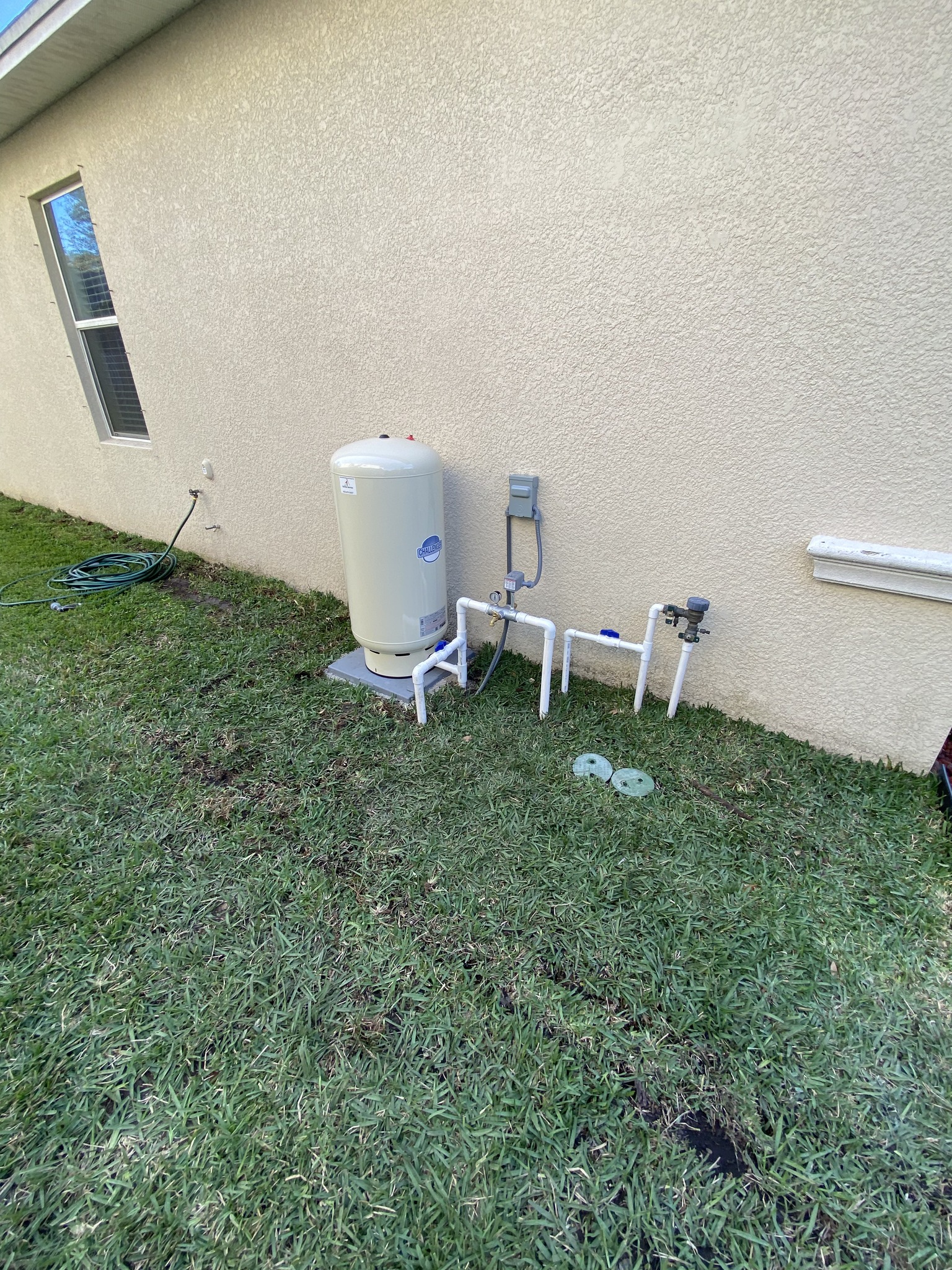
The tank helps maintain pressure and reduces unnecessary pump starts. Problems with it are commonly associated with pressure fluctuations and frequent cycling.
However, if the pump runs continuously and cannot build pressure, the technician also needs to determine whether the pump is moving water and whether the system is losing water or pressure elsewhere.
Replacing a pressure tank without diagnosing the complete system can result in replacing a component that wasn’t responsible for the original failure.
What Can You Safely Check Yourself?
Homeowners can make several observations without opening electrical equipment or dismantling the well system.
Check whether the problem affects the entire house
Try more than one fixture.
If one faucet has poor flow while everything else operates normally, the problem may be localized. If every fixture has lost water, a well-system or main-supply problem becomes more likely.
Check the electrical panel
Look for a tripped breaker.
A breaker that trips again after being reset can indicate a problem requiring diagnosis. Do not repeatedly reset it.
Look at the pressure gauge
If your system has an accessible gauge, note its reading without adjusting anything.
A pump that runs while system pressure remains unusually low provides useful diagnostic information for the technician.
Listen to the system
Pay attention to whether the pump:
- Runs continuously
- Starts and stops rapidly
- Hums without normal operation
- Sounds noticeably different than usual
You don’t need to identify the failure yourself. These observations simply make troubleshooting more efficient.
What Should You Avoid Doing?
A no-water situation can tempt homeowners into experimenting with the system.
Avoid:
❌ Opening electrical controls while energized
❌ Repeatedly resetting a breaker that continues to trip
❌ Randomly changing pressure-switch settings
❌ Pulling a submersible pump without appropriate equipment
❌ Assuming the pump needs replacement before the system is tested
❌ Allowing a pump to continue running indefinitely without delivering water
Well systems combine electricity, pressurized water, plumbing, and equipment that may be located deep inside the well. Diagnosis matters more than replacing the first component that appears suspicious.
Pump Failure vs. Well Problem: Why the Difference Matters
Consider two homes with exactly the same symptom:
Home A: The pump runs, but worn pump components prevent it from developing adequate pressure.
Home B: The pump runs correctly, but the well isn’t providing enough water.
Both homeowners may describe the problem as “my well pump runs but I have no water.”
The appropriate solutions, however, are completely different.
This distinction is important because effective well repair isn’t simply about determining whether a motor turns on. The technician needs to evaluate how the entire water-delivery system behaves.
What Does Professional Diagnosis Typically Focus On?
The objective is to determine where water delivery is failing.
Depending on the system and symptoms, evaluation may involve checking:
- Whether the pump receives and responds to power correctly
- Whether the system develops pressure
- Pump performance
- Pressure-switch operation
- Pressure-tank condition
- Accessible piping and connections
- Whether the system maintains pressure
- Conditions suggesting a problem with water availability
The exact diagnostic process depends on the type of well and equipment installed.
A repair shouldn’t begin with an assumption.
If you’re in the Galan Well Drilling & Pump Inc. service area and your pump is running without restoring water, having the well and pump system diagnosed can determine whether you’re dealing with a pump problem, pressure-system failure, piping issue, or another condition before unnecessary components are replaced.
Can This Problem Be Prevented?
Not every pump or well failure can be prevented. Mechanical equipment eventually wears, electrical components can fail, and well conditions can change.
What homeowners can do is pay attention to changes before complete water loss occurs.
Don’t ignore:
- Pressure that has gradually weakened
- A pump taking longer to shut off
- Frequent cycling
- Air or sputtering at faucets
- Unusual equipment noises
- Changes in water delivery
These symptoms don’t prove a particular component is failing. They are reasons to investigate the system before the problem becomes more disruptive.
✅ The Bottom Line
If your well pump is running but no water is reaching the house, don’t assume immediately that you need a new pump.
The system may be dealing with inadequate water supply, loss of prime on an applicable system, a leak, pump-performance problems, or another pressure-related failure.
The safest approach is to make basic observations, avoid invasive electrical or mechanical troubleshooting, and have the system diagnosed if normal water service doesn’t return.
Galan Well Drilling & Pump Inc. can evaluate well and pump problems and determine what part of the system actually needs attention before recommending repair or replacement.
Frequently Asked Questions
Why can I hear my well pump running but have no water?
The pump may be operating without successfully moving enough water or developing adequate system pressure. Possible causes include pump problems, inadequate water availability, piping failures, or loss of prime in applicable systems.
Can a well pump run if the well is out of water?
A pump may continue attempting to operate when adequate water isn’t available. Because operating without sufficient water can damage certain pumps, continuous running with no water delivery should be investigated promptly.
Why won’t my well pump build pressure?
Possible causes include insufficient pump output, a leak or other loss of pressure, inadequate water supply, or another problem within the well system. Testing is needed to distinguish between them.
Should I reset my well pump breaker?
You can check whether the breaker has tripped. If it trips again, don’t continue resetting it. Repeated tripping can indicate an electrical or equipment problem requiring professional diagnosis.
Does no water mean I need a new well pump?
No. A complete loss of water can have several causes. The pump, electrical controls, pressure system, piping, or well conditions should be evaluated before deciding that pump replacement is necessary.
How quickly should a continuously running well pump be checked?
Promptly. If the pump runs continuously without restoring normal water service or pressure, continued operation may place unnecessary stress on the equipment.